

Fertility Supplements Market Projected to Reach USD 5.153 Billion by 2035 Driven by Rising Reproductive Health Awareness
Fertility Supplements Market
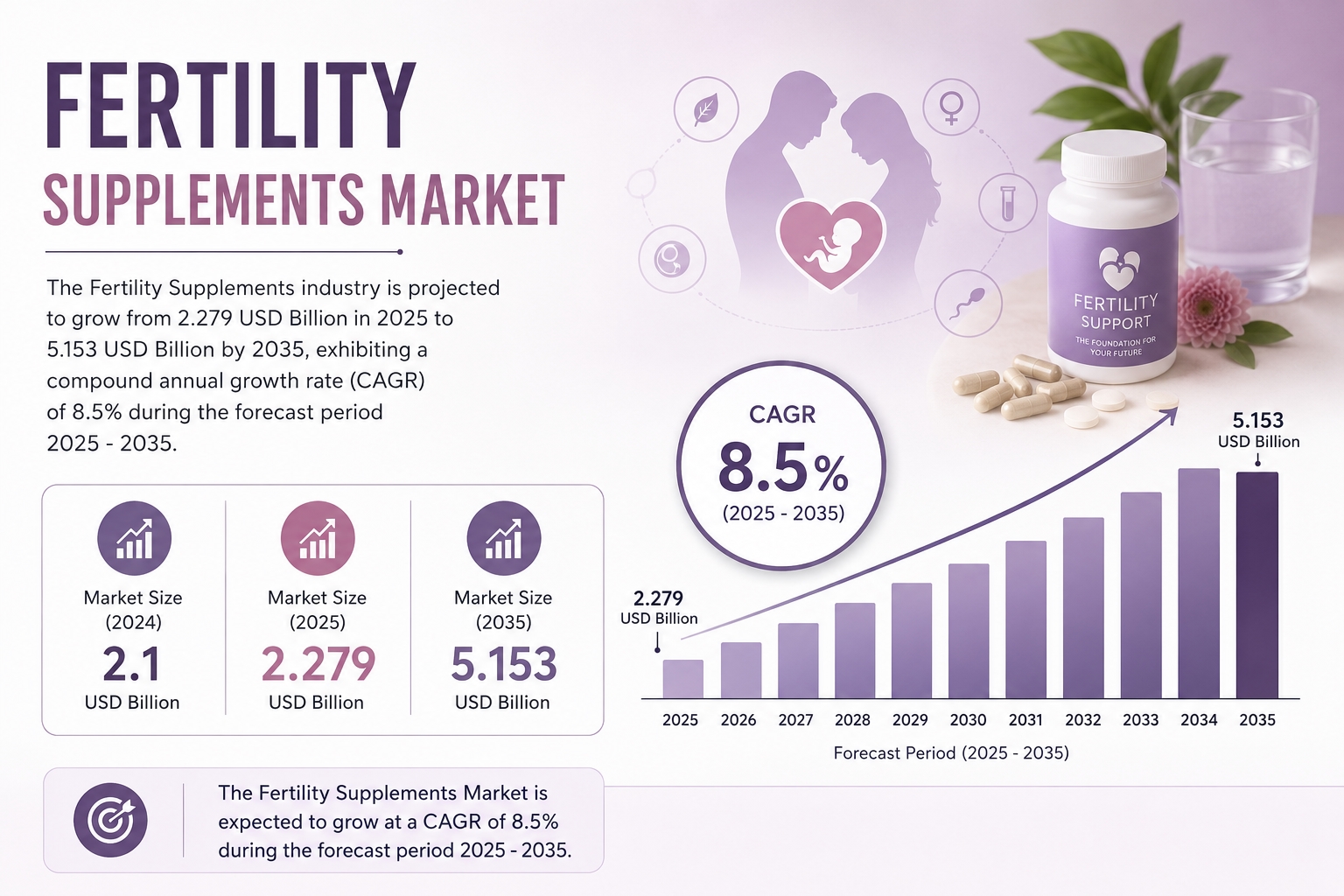
Global Market Expands at 8.5% CAGR (2025–2035) as Demand for Nutritional, Plant-Based, and Clinically Supported Fertility Supplements Accelerates
NEW YORK, NY, UNITED STATES, June 18, 2026 /EINPresswire.com/ -- The global Fertility Supplements Market is entering a sustained growth phase driven by increasing awareness of reproductive wellness, delayed parenthood trends, lifestyle-related fertility challenges, and growing preference for natural, non-invasive health solutions. According to market projections, the industry valued at USD 2.1 billion in 2024 is expected to reach USD 2.279 billion in 2025 and further expand to approximately USD 5.153 billion by 2035, registering a steady compound annual growth rate (CAGR) of 8.5% during 2025–2035.The fertility supplements industry is transitioning from a niche wellness category into a mainstream segment of the global nutraceuticals market. Consumers are no longer relying solely on clinical fertility treatments; instead, they are incorporating preventive nutrition-based solutions to enhance reproductive health early.
Modern lifestyles characterized by stress, irregular sleep cycles, poor dietary habits, environmental pollution, and sedentary behavior have contributed to declining fertility rates globally. As a result, fertility supplements containing essential nutrients such as folic acid, zinc, omega-3 fatty acids, vitamin D, CoQ10, and herbal extracts are witnessing increased adoption.
Market Drivers: Key Forces Fueling Growth:
Increasing Awareness of Natural Fertility Solutions-
One of the most significant growth drivers is the rising awareness of natural fertility enhancement options. Consumers are increasingly shifting away from synthetic drugs and invasive treatments toward plant-based and nutritionally balanced supplements.
Educational campaigns by healthcare providers, digital health platforms, and wellness influencers have played a crucial role in spreading awareness about fertility nutrition. This has resulted in a growing acceptance of supplements as a first-line approach to reproductive wellness.
Delayed Parenthood and Lifestyle Changes-
A major societal shift toward delayed marriages and later pregnancies has significantly influenced demand. Individuals focusing on education, careers, and financial stability often experience age-related fertility decline later in life, increasing reliance on supplements that support reproductive function.
Additionally, modern lifestyle patterns—including high stress levels, obesity, and exposure to environmental toxins—have contributed to reduced fertility rates, further boosting supplement consumption.
Advancements in Nutraceutical Formulations-
Innovation in supplement formulation has significantly improved product effectiveness and consumer trust. Companies are developing targeted blends for male and female fertility, incorporating clinically studied ingredients such as myo-inositol, L-carnitine, folate complexes, and antioxidant-rich herbal extracts.
These advancements are making fertility supplements more specialized, effective, and appealing to a wider demographic.
Market Restraints: Challenges Affecting Expansion:
Despite strong growth prospects, the market faces several limitations. One of the key challenges is the lack of standardized clinical validation for many fertility supplement products. While certain ingredients have scientific backing, overall product efficacy varies widely across brands.
Additionally, regulatory differences across regions create complexities in product approval and marketing claims. Misleading advertising practices in some markets have also led to consumer skepticism, impacting trust levels.
Another constraint is the relatively high cost of premium fertility supplements, which may limit accessibility in price-sensitive markets, particularly in developing economies.
Market Opportunities: Expanding Potential Across Regions:
Growing Demand in Emerging Economies-
Emerging economies in Asia-Pacific, South America, and parts of the Middle East are expected to present significant opportunities. Rising disposable incomes, increasing urbanization, and improving healthcare awareness are driving demand for fertility-enhancing nutraceuticals in these regions.
Expansion of Male Fertility Segment-
Historically, fertility solutions have been focused on women. However, increasing recognition of male infertility factors has opened new avenues for product innovation. Supplements targeting sperm quality, motility, and testosterone balance are gaining strong traction.
Digital Health and E-Commerce Growth-
The rapid expansion of online retail and telehealth platforms has made fertility supplements more accessible than ever. Consumers now prefer discreet online purchasing options, subscription models, and personalized supplement recommendations based on digital health assessments.
Market Segmentation Analysis:
By Product Type-
The market includes vitamins, herbal supplements, minerals, and specialty fertility blends. Vitamin-based formulations dominate due to their essential role in reproductive health, particularly folic acid and vitamin D. However, herbal supplements are gaining popularity due to increasing preference for natural and plant-derived ingredients.
By Formulation-
Fertility supplements are available in tablets, capsules, powders, and liquid formats. Capsules and tablets remain the most widely used due to convenience and precise dosing. However, liquid formulations are gaining attention among consumers seeking faster absorption and easier consumption.
By End User-
The market is segmented into male, female, and unisex fertility supplements. Female fertility supplements currently hold a larger share, but the male segment is expected to grow faster due to rising awareness of male reproductive health.
By Distribution Channel-
Retail pharmacies, online platforms, supermarkets, and specialty health stores represent key distribution channels. Online sales are experiencing the fastest growth, driven by convenience, privacy, and access to a wide range of brands.
Regional Analysis: Global Market Distribution:
North America-
North America remains a dominant market due to high awareness levels, advanced healthcare infrastructure, and strong presence of key nutraceutical companies. Consumers in the region are highly inclined toward preventive health solutions, contributing to strong demand.
Europe-
Europe is witnessing steady growth supported by increasing adoption of natural supplements and strong regulatory frameworks ensuring product quality. Countries such as Germany, the UK, and France are leading contributors.
Asia-Pacific-
Asia-Pacific is expected to register the fastest growth rate during the forecast period. Rising infertility rates, increasing stress levels, and growing acceptance of wellness supplements are key growth drivers in countries such as India, China, and Japan.
South America and Middle East & Africa-
These regions are gradually emerging as potential markets due to improving healthcare awareness and expanding distribution networks, although adoption remains in early stages compared to developed regions.
Competitive Landscape: Key Industry Players:
Leading companies are increasingly focusing on research-backed formulations, improved bioavailability technologies, and transparency in ingredient sourcing to strengthen consumer trust. Branding, digital marketing, and e-commerce expansion also play a critical role in maintaining market positioning, especially as consumers increasingly purchase supplements through online platforms.
Key industry participants include:
⊡ Vitafusion – A major player known for its widely accessible gummy vitamins, expanding its presence in fertility-focused nutrition through convenient and consumer-friendly formulations.
⊡ Garden of Life – Recognized for its organic and whole-food-based supplements, the company emphasizes clean-label fertility support products derived from natural ingredients.
⊡ Zahler – Focuses on scientifically formulated nutritional supplements, including targeted fertility blends designed for reproductive wellness in men and women.
⊡ New Chapter – Specializes in fermented, herbal-based vitamins, leveraging botanical science to support hormonal balance and reproductive health.
⊡ Thorne Research – Known for premium, clinician-trusted formulations, offering advanced fertility supplements with high-quality ingredient standards and rigorous testing protocols.
⊡ MegaFood – Focuses on whole-food nutrition, producing fertility-support supplements designed for optimal nutrient absorption and long-term wellness.
⊡ Nature's Way – A well-established herbal supplement brand providing plant-based fertility support products aligned with traditional and modern wellness approaches.
⊡ Herb Pharm – Specializes in liquid herbal extracts, offering botanical fertility formulations aimed at natural reproductive system support.
These companies are actively investing in product innovation, clinical validation, and expansion into emerging markets. Strategic initiatives such as partnerships with healthcare professionals, influencer-driven marketing, and subscription-based wellness programs are further strengthening their competitive positioning in the rapidly evolving fertility supplements landscape.
Technological and Product Innovation Trends:
Innovation is playing a central role in shaping the future of fertility supplements. Personalized nutrition based on genetic testing and hormonal profiling is gaining momentum. Consumers are increasingly seeking customized supplement plans tailored to their reproductive health status.
Additionally, advancements in encapsulation technology are improving nutrient stability and bioavailability, ensuring better absorption of active ingredients.
Plant-based and clean-label formulations are also becoming industry standards, driven by consumer demand for transparency and sustainability.
Future Outlook: Strong Growth Trajectory Ahead:
The fertility supplements industry is expected to maintain robust growth over the next decade, driven by evolving consumer lifestyles, increasing health awareness, and continuous product innovation. The integration of digital health tools, personalized nutrition, and scientific research will further strengthen market expansion.
As fertility challenges continue to rise globally, supplements are expected to play an increasingly important role in preventive reproductive healthcare. Companies that focus on clinical validation, ingredient transparency, and personalized solutions are likely to lead the next phase of market development.
Conclusion:
The global Fertility Supplements Market is undergoing a significant transformation, shifting from basic nutritional support products to advanced, science-backed reproductive health solutions. With strong demand drivers, expanding consumer awareness, and continuous innovation, the market is set to nearly double in size over the next decade, reaching USD 5.153 billion by 2035.
This growth trajectory highlights a long-term opportunity for nutraceutical companies, healthcare providers, and digital wellness platforms to shape the future of reproductive health management through safe, effective, and accessible fertility support solutions.
Discover More Research Reports on Consumer and Retail by Market Research Future:
sanitary napkin market: https://www.marketresearchfuture.com/reports/sanitary-napkin-market-67772
Feminine Hygiene Market: https://www.marketresearchfuture.com/reports/feminine-hygiene-market-7986
Essential Oil Aromatherapy Market: https://www.marketresearchfuture.com/reports/essential-oil-aromatherapy-market-3319
Sagar Kadam
Market Research Future
+1 628-258-0071
email us here
Visit us on social media:
LinkedIn
Facebook
X
Legal Disclaimer:
EIN Presswire provides this news content "as is" without warranty of any kind. We do not accept any responsibility or liability for the accuracy, content, images, videos, licenses, completeness, legality, or reliability of the information contained in this article. If you have any complaints or copyright issues related to this article, kindly contact the author above.
